
Could a simple mowing plan suit your yard better than a long list of treatments? The best lawn care service is the one that matches the work your property needs, not simply the longest list of services. Homeowners, contractors, and property managers can use the same rule: define the work before agreeing to a price.
Mowing frequency means the interval between scheduled cuts. Your priorities may be recurring mowing, lawn treatments or a broader property project. This comparison helps Blue Ridge homeowners with sloped lots, along with Virginia contractors and property managers checking obligations before building, compare those needs.
Start by naming the work, then compare the schedule and terms. That approach can help you avoid paying for services your grass or property does not need. A sloped yard or planned land alteration makes it especially important to check the work scope before agreeing to a service.
Key Takeaways
- Match service type to the work your yard needs.
- Compare mowing frequency, not just visit prices.
- Ask how grass height and slope affect the estimate.
- Check reviews, insurance, and written service terms.
- Confirm Virginia rules for construction or pesticide work.
How Much Does Lawn Care Cost in 2026?
Professional mowing typically costs $30-$85 per visit in 2026, with a national average of about $50. Your lawn size, mowing frequency and grass height shape the actual cost.
Recurring mowing by lawn size
The table shows typical lawn mowing prices by yard size and schedule. An acre contains 43,560 square feet, so measure the turf area rather than the whole property when comparing quotes.
| Lawn size | Weekly | Every two weeks | Monthly |
|---|---|---|---|
| About 1/8 acre | $30-$40 | $40-$50 | $50-$60 |
| 1/4 acre | $45-$65 | $60-$85 | $70-$100 |
| 1/2 acre | $50-$75 | $65-$100 | $80-$120 |
| 1 acre | $60-$100 | $80-$150 | $95-$180 |
Monthly cuts often cost 50-80% more per visit than weekly cuts because grass grows taller between visits. Lawn-care professionals commonly charge flat visit fees, though hourly rates typically range from $32-$68.
One-time cuts, overgrowth and add-ons
A standard suburban mowing visit typically costs $45-$65. One-time mowing for a standard yard often costs $60-$120, while an overgrown lot may cost $100-$250.
A seriously overgrown half-acre can cost about $200-$400. For a 5,000-square-foot lawn, one calculator estimates $75 for a one-time cut, with weekly service at $63.75 per visit and a $52.50-$135 range.
Grass taller than 10 inches can add $20-$60 above the standard rate. The average lawn mowing cost is about $50 per visit nationally, but location and cut conditions change the bill. The 2026 mowing price guide also lists hourly rates and tall-grass surcharges. Ask whether an over-10-inch lawn triggers a surcharge before the first cut.
How to Choose the Best Lawn Care Service for Your Yard
For a homeowner who wants treatments bundled with a tailored lawn plan, TruGreen is the strongest named plan option here; a mowing-focused service fits a simpler grass-cutting need. Choose based on the work your lawn needs and the time you can give it.
Routine mowing and maintenance
Routine lawn services usually cover mowing, trimming, edging, and cleanup. Broader lawn maintenance may also include irrigation work, mulching, leaf removal, tree and shrub care, weed control, or pest services.
A local lawn care service in Roanoke offers examples such as mowing, aeration, overseeding, flowerbed care and seasonal cleanup. Full-service lawn care brings mowing together with other treatments, so check which tasks the bundle actually includes.
Treatments, renovation and bundled plans
TruGreen plans add treatments to routine lawn care. A quarter-acre full-service package can cost $65-$100 or more per week in 2026; lawn maintenance averages $100-$410 per month, depending on the services.
| TruGreen plan | Included base services | Added services or protections |
|---|---|---|
| TruBasic | Lawn assessment, tailored plan | Fertilization and weed control |
| TruCore | TruBasic services | Insect control and soil enhancer |
| TruPro | TruCore services | Aeration, overseeding, guarantee |
Typical 2026 prices include $67-$405 for fertilization, $107-$202 for aeration and $107-$435 for leaf removal. Seeding costs $427-$1,514, while sod installation costs $2,028-$3,394.
TruGreen also sells mosquito, flea and tick, tree and shrub, perimeter pest, lawn-damaging insect and lawn disease services. Aeration works best when soil is moist, and you should flag sprinkler heads first. Match the service list to the problem you want solved instead of paying for treatments your yard does not need.
How Do You Compare Lawn Care Companies?

A high star rating is useful context, but the platform, date and number of reviews matter just as much. Ratings cover different review pools, and a small number of reviews may not reflect a company’s usual service.
TruGreen had a BBB business rating of A+ and a BBB customer rating of 1 out of 5 stars, accurate as of January 2025. Sunday Lawn Care also had an A+ BBB business rating and a 1-out-of-5 customer rating, with three BBB customer reviews.
Sunday had a 3.5-out-of-5 Trustpilot rating in a 2026 comparison. These examples show why the date, platform, and review count matter more than one score alone. Best lawn care service reviews should help you form questions, not promise a certain result.
- Verify the lawn care professional’s liability insurance.
- Read recent reviews across more than one platform.
- Confirm who will do the work at your property.
- Read the service guarantee and its reporting deadline.
LawnStarter requires its professionals to carry liability insurance. It offers a re-mow or refund guarantee when a customer reports a problem within five days of service.
A lawn care gig app can simplify scheduling and payment, but you still need to check the local professional’s coverage and work scope. Save the written guarantee and note its complaint deadline before the first visit.
What Should Sloped Blue Ridge Lots Require?
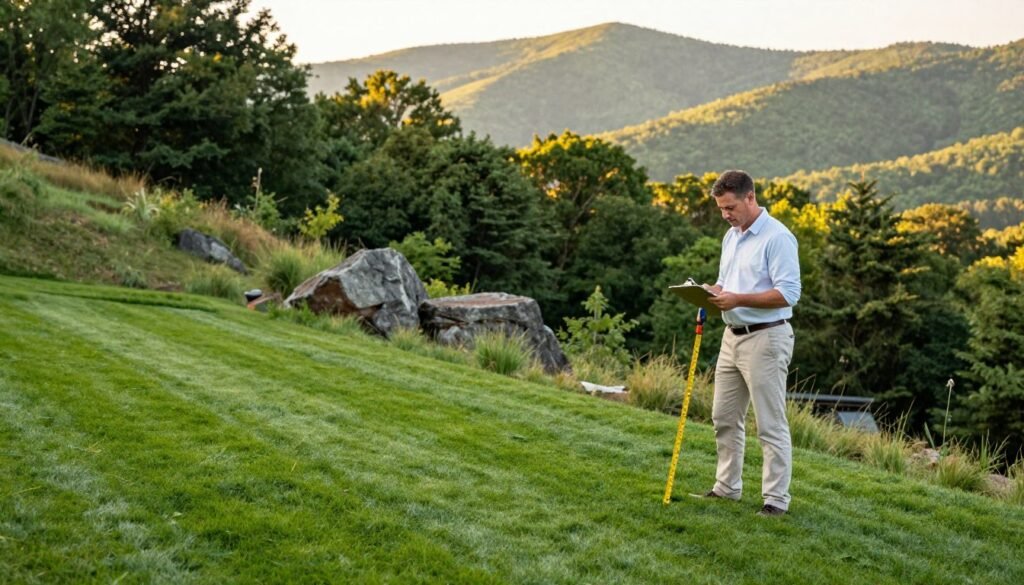
A sloped Blue Ridge lot needs an estimate based on the actual grade and access, not just its square footage. Slope can affect equipment choice, how long mowing takes, and whether a crew can reach each area safely.
Mowing on steep grades
A lawn care professional should assess the grade and access before setting the work scope. One 2026 calculator applies a 1.15x multiplier for a moderate slope and a 1.35x multiplier for a steep slope.
Those figures are that calculator’s pricing assumptions, not universal surcharges or market prices. Ask how the crew plans to handle steep sections and what equipment it will use. A walk-through can reveal limits that a map or square-foot estimate misses.
Obstacles, drainage and access
Point out garden beds, trees, steps and narrow gates during an on-site review. Also show any erosion, standing water or drainage concerns that could affect mowing or other landscaping work.
The same calculator applies a 1.30x multiplier for thick or overgrown grass and another 1.30x multiplier for heavy obstacles. These are calculator-specific examples, not standard rates for every yard.
Active erosion may call for a repair plan before regular lawn work. Fairfax County recommends suitable vegetation or mulch for lighter erosion, and terraces or check dams for steep slopes or concentrated water flow. Its erosion and drainage guidance describes ways to limit runoff.
Ask the local professional to identify which areas are included and how steep or hard-to-reach sections will be handled.
How Often Should You Schedule Lawn Maintenance?
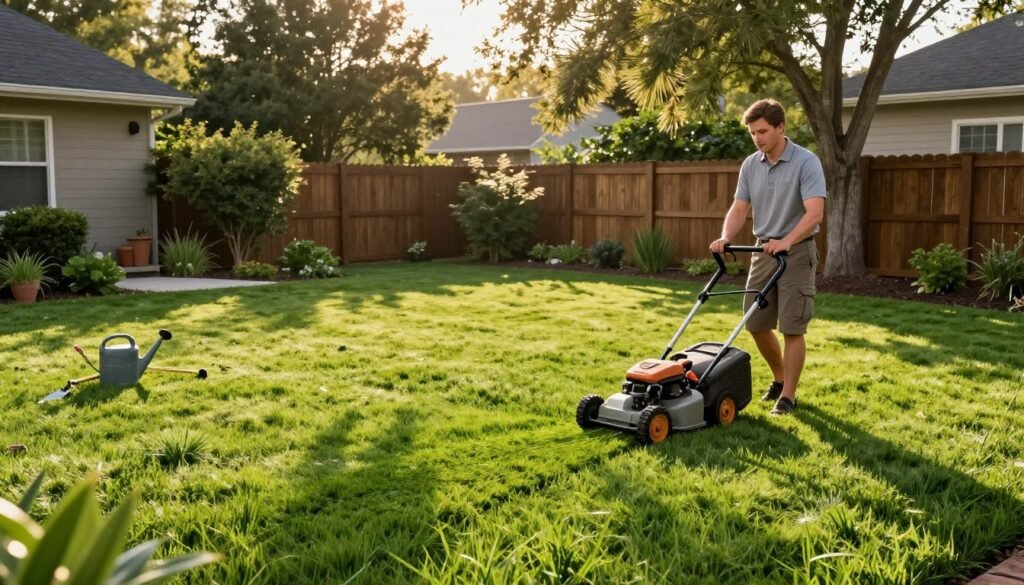
Weekly mowing is a sensible starting point during active growth, but the grass itself should determine the final schedule. Set mowing frequency by how quickly your lawn grows, not by a fixed calendar alone.
Fast growth may call for weekly cuts. Slow growth, dry weather or limited sunlight can mean fewer visits because the grass grows less quickly.
Use the one-third rule to protect the lawn: never remove more than one-third of a grass blade in a single mowing. Cutting too much at once can leave the turf stressed and uneven.
One 2026 calculator discounts its base mowing price by 15% for weekly service, 10% for service every two weeks and 5% for monthly service. Those discounts describe that calculator’s pricing model, not a universal industry rule.
Look at the grass before each visit, especially after dry weather or a growth spurt. A schedule based on actual growth can help prevent both needless cuts and an overly harsh trim.
If the grass has grown too tall to cut safely within the one-third rule, ask for a staged cut rather than stripping it short at once.
What Virginia Licensing Rules Apply to Lawn Work?

In Virginia, ordinary mowing is not automatically the same as regulated landscape construction or pesticide application. Basic maintenance may not require a state contractor license when it stays below contractor monetary thresholds.
Land alteration can trigger contractor licensing through the Department of Professional and Occupational Regulation (DPOR). Applying herbicides or other pesticides for hire requires Commercial Pesticide Applicator certification from the Virginia Department of Agriculture and Consumer Services (VDACS).
- Excavation, grading or retaining walls.
- Drainage work or hardscape construction.
- Herbicide or other pesticide application for hire.
Virginia’s Landscape Service Contractor specialty has Class C, B, and A license levels. Class C contracts cannot exceed $10,000 each or $150,000 in annual revenue; listed fees are $235 plus $25 for the Recovery Fund.
Class B contracts cannot exceed $120,000 each or $750,000 in annual revenue; listed fees are $380 plus $25. Class A has no project-value cap as of September 1, 2025, with listed fees of $400 plus $25.
The specialty exam has 50 questions and allows 120 minutes. You need 70%, or 35 correct answers, to pass. Review the Virginia license limits and exam rules for the Landscape Service Contractor specialty. Before a project begins, confirm the specific scope and current requirements with DPOR and VDACS.
What Should You Ask Before Hiring a Pro?
Ask each provider to quote the same work on the same schedule so the estimates are comparable. A lawn care instant quote is a useful starting point, but confirm lawn size, slope, grass height, and included tasks before you accept it.
Lawn service quotes are easier to compare when they state mowing frequency, trimming, clipping or yard waste cleanup, travel charges, and add-on work. Request a written, itemized lawn care estimate, then collect three estimates as a practical comparison rule.
For larger landscaping or hardscape jobs, a landscape and hardscape consultation can help define the project before work starts. The quote should make clear which areas and tasks the price covers.
- Work scope, including the turf area and tasks.
- Schedule, including mowing frequency and start date.
- Additional charges, including travel and add-on work.
- Cleanup responsibility for clippings and yard waste.
Check whether the estimate includes trimming around beds and trees, and whether the crew will remove clippings. Ask how changes to the work will affect the price, especially if the lawn’s condition differs from the first description.
Keep the accepted scope and any agreed changes in writing before the first visit.
Conclusion
A good choice starts with a clear scope for the work your property actually needs. Match the service to the turf area, conditions and schedule, then use the same details when comparing estimates.
Virginia homeowners and property managers should check licensing when a project goes beyond routine maintenance. That distinction matters before work involving land changes or pesticide use begins.
Write down the areas, tasks, and cleanup terms you expect. Request a written estimate that accounts for your yard’s conditions before you schedule service.